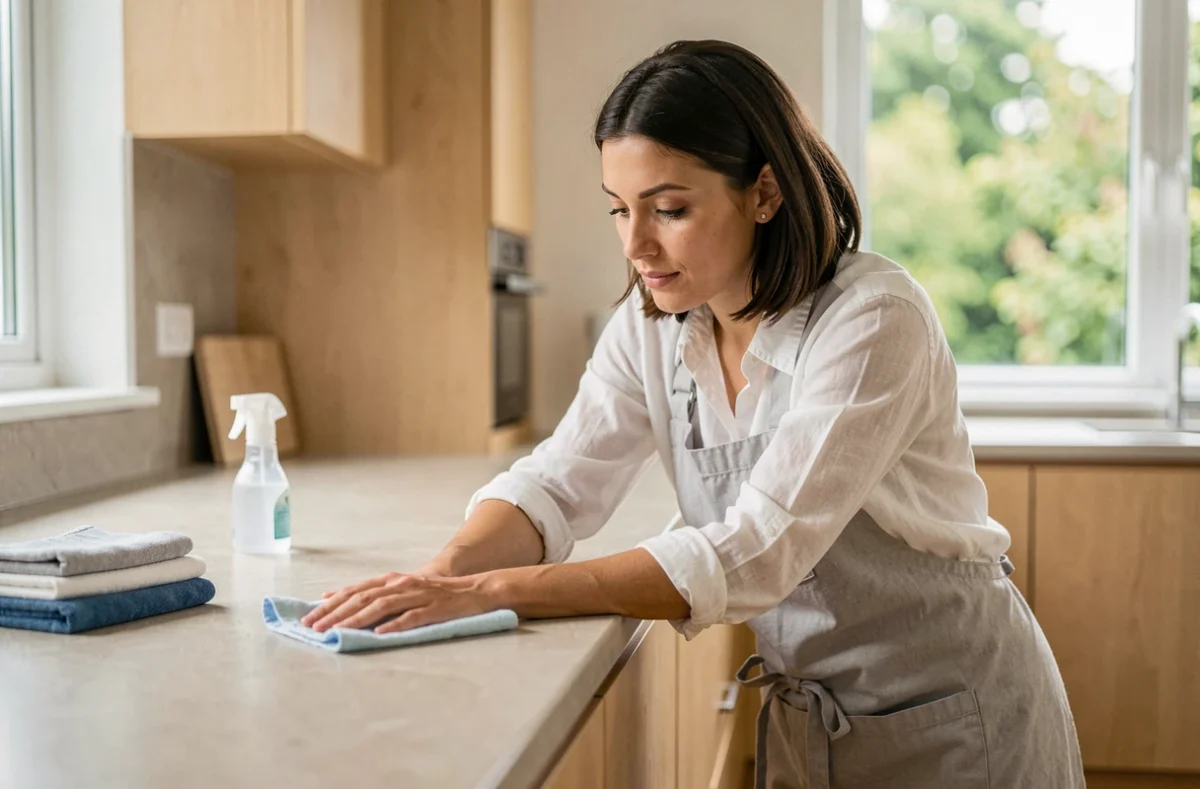
Cleaning the house takes time, energy, and sometimes products whose labels we don’t always read. Between the homemade recipes circulating online and industrial products with opaque compositions, practices vary greatly from one household to another. Here are ten concrete tips, each focused on a specific action or product, to maintain your interior daily without wasting or taking unnecessary risks.
1. Clean limescale surfaces with diluted white vinegar
White vinegar is primarily a descaler. It dissolves mineral deposits on faucets, shower walls, and stainless steel sinks. Diluted in warm water, it acts within minutes on white stains without requiring intensive scrubbing.
However, white vinegar can damage marble or limestone surfaces. Before applying it to a countertop or natural stone tiles, testing it on a discreet area avoids unpleasant surprises. Its action is limited to limescale: it does not replace a disinfectant when one is truly needed.
For those looking for other cleaning tips for the home, white vinegar is a good starting point, provided you know its limits.
2. Apply the single product rule per surface
Mixing two cleaning products in the hope of doubling their effectiveness is a common but risky reflex. Anses reports that bleach combined with vinegar or a descaler can release toxic chlorine gas. Heat and concentrated products exacerbate this release.
The simplest precaution is to use only one product at a time on each surface, then rinse thoroughly before changing. This action is enough to eliminate the majority of emission risks during regular cleaning.
3. Wear gloves for homemade preparations
Homemade cleaning products (made with baking soda, black soap, or washing soda) are not automatically safe. Anses notes cases of poisoning, mainly skin or eye irritations, during preparations made without protection.
Classic household gloves and, for volatile powders, protective goggles reduce these risks. It’s not about the toxicity of the finished product, but about prolonged contact with concentrated substances during preparation.

4. Descale the kettle and coffee maker weekly
Limescale accumulates quickly in appliances that heat water. A scaled kettle consumes more energy and alters the taste of beverages. A cycle with water mixed with white vinegar, followed by a rinse with clear water, is enough to keep the appliance in good condition.
This weekly habit takes less than ten minutes and extends the lifespan of the heating elements, avoiding premature replacement.
5. Read the label of detergents before purchase
The European regulation on detergents requires manufacturers to mention certain ingredients, fragrances, and allergens on the packaging. Online access to the complete list of components is also provided by this regulation.
Taking thirty seconds to read the usage precautions and pictograms allows you to adjust the dosage and spot products incompatible with certain surfaces. Irritation pictograms (exclamation point in a red diamond) indicate products that require gloves.
6. Prefer microfiber cloths for floors and windows
A damp microfiber cloth captures dust and greasy residues without adding product. On hard floors (tiles, varnished parquet), a flat mop equipped with a microfiber cloth effectively replaces daily vacuuming for light dirt.
Microfiber reduces the consumption of cleaning product because its fine structure catches particles through friction. A machine wash at low temperature after each use is enough to restore it, without fabric softener (which clogs the fibers).
7. Clean tile joints with black soap
Bathroom joints darken due to humidity and soap residues. Pure black soap applied with an old toothbrush cleans the joints without damaging them. Letting it sit for a few minutes before scrubbing improves the result.
This action, repeated every two weeks, avoids the need for chlorinated products that ultimately weaken the joint and accelerate its crumbling.
8. Ventilate while cleaning to limit exposure to fumes
Indoor air quickly becomes loaded with volatile compounds as soon as a cleaning product is used, even natural ones. Opening windows during and after cleaning creates a draft that evacuates these emissions. Ventilating for at least fifteen minutes after cleaning is a habit that protects the respiratory system, especially in small rooms like the bathroom.
This simple reflex partially compensates for the lack of mechanical ventilation in older homes.
9. Measure products with a cap rather than by instinct
Overdosing a cleaning product does not make it more effective. An excess of laundry detergent leaves residues on clothes, an excess of dish soap generates difficult-to-rinse foam, and an excess of floor cleaner creates a sticky film that attracts dust.
- Use the measuring cap provided with the product as a unit of measurement rather than pouring by eye.
- Reduce the dose by half when the dirt is light (dust, fingerprints).
- Always rinse with clear water after application, especially on floors where you walk barefoot.
10. Maintain the sponge to avoid bacterial proliferation
A damp sponge left by the sink provides a favorable environment for bacteria to multiply. Wringing out the sponge after each use and letting it air dry slows this proliferation.
Replacing the sponge every two weeks remains the most reliable method. Sponges made from plant cellulose dry faster than synthetic sponges, which limits moisture stagnation between uses.
Each of these ten practices works independently of the others. Adopting those that fit your habits, without trying to apply them all at once, is enough to improve daily home maintenance while limiting risks associated with products.