Converting measurements in cooking is essential for successfully executing recipes, especially when faced with instructions that do not match the utensils or measurement systems one is accustomed to. Whether it’s translating teaspoons into milliliters or cups into grams, precision is key. The differences between American, British, and metric measurements can be confusing. Fortunately, there are tips and tools to simplify these conversions and ensure that each ingredient is measured accurately, thereby guaranteeing the success of any culinary preparation.
10cl to ml
The Fundamentals of Measurement Conversion in Cooking
Cooking, a science of precision, requires a clear understanding of units of measurement and their conversion. For example, converting ’10cl to ml’ is a common task, achievable through the knowledge that 1 centiliter (cl) equals 10 milliliters (ml). This basic relationship is a cornerstone for volume measurements, and mastering it is a prerequisite for anyone aspiring to excel in gastronomy.
Regarding weight measurements, the distinction between gram (g) and kilogram (kg) is equally fundamental. Recipes may require conversions such as changing 100 g to 0.1 kg or vice versa, knowing that 1 kg represents 1000 g. Having a conversion chart is therefore a valuable tool that allows one to navigate between these units with confidence and accuracy.
Temperatures, often indicated in degrees Celsius (°C) or Fahrenheit (°F), require a different approach. The freezing point of water, 0°C, equals 32°F, providing an essential reference point for thermal conversions needed in recipes that require strict heat control. Conversion formulas or online calculators can be used to facilitate these adjustments.
Precision in measurement conversion is a guarantee of success in cooking. Converting measurements in cooking accurately ensures fidelity to recipes and significantly contributes to the consistency of culinary results. Whether it’s volumes, weights, or temperatures, the accuracy of conversions is a skill that every cook, amateur or professional, should cultivate.
Techniques and Tips for Accurate and Easy Conversion
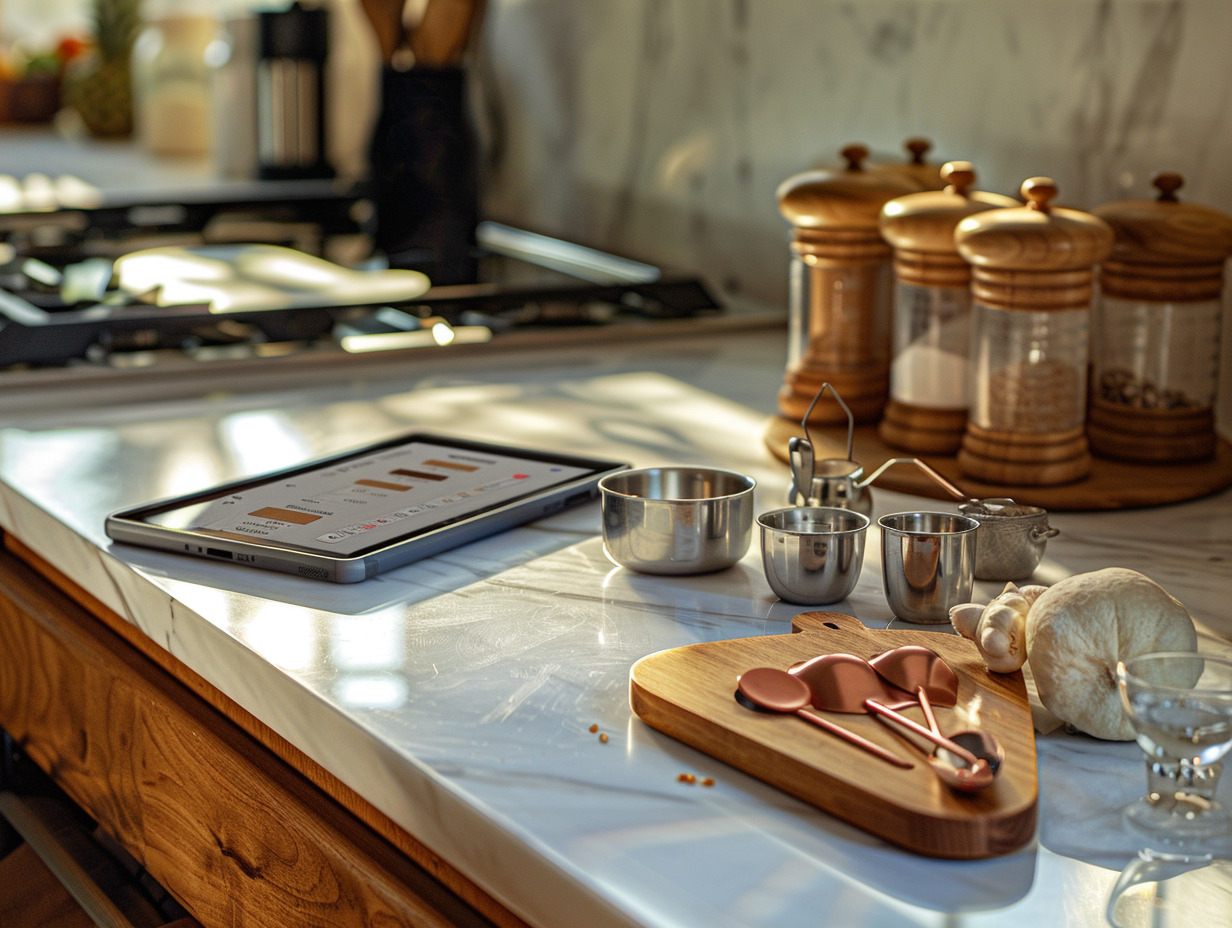
Mastering conversions in cooking relies on techniques and tips that make life easier for cooks. Using a kitchen scale is often recommended for measuring ingredients with the utmost precision, especially for weight measurements such as converting grams to kilograms or vice versa. The accuracy of these instruments allows for following recipes to the letter and ensuring consistency in flavors and textures.
For volume measurements, common kitchen tools like tablespoons and teaspoons can be very helpful. They provide practical equivalents for small liquid quantities, where converting centiliters to milliliters, with a factor of 10, might prove too meticulous to do manually. Knowing standard equivalents is therefore essential for adapting recipes based on available utensils.
When it comes to ingredients such as flour, often measured in cups, the relationship between volume and weight can be surprising. For example, 1 cup of water weighs 237 grams, useful information for conversions between volumetric and weight measurements. This knowledge is particularly advantageous when adjusting quantities for ingredients that are more or less dense than water.
For culinary conversions, digital tools and conversion apps offer a quick and effortless solution. They allow for easy conversion of all sorts of measurements, including temperatures from degrees Celsius to degrees Fahrenheit and vice versa. Familiarity with basic equivalents and regular practice of manual conversions remains an asset for any cook wishing to excel without relying entirely on technology.